In response to
Venkatesh Rao's Blyg · Venkatesh Rao · “I convinced myself of several things today, based on a basic premise about AI: A…” · item 4stcza8sk5v5k4w1k15dt16xnn, v2 · <https://venkateshrao.com/blyg/t/4stcza8sk5v5k4w1k15dt16xnn/> · retrieved Oct 29, 2026
Protocols Over Paeans to Techno-Progress
This reframing of AI as a variable purpose technology is subtle and important.
AI is the most variable-value technology ever invented. One sign is that you don’t know whether a token is worth a penny or a million dollars without knowing what problem it’s being applied to under what conditions. So it’s best to think of it as a variable-purpose technology rather than a general-purpose technology. This is extremely weird. While many economic goods have values that depend on context, especially under distorted market conditions, this is the first good whose value depends entirely on context, even in undistorted perfect market conditions.
from Venkatesh Rao's Blyg ↗ · excerpt of v2
One mapping I'm noodling is between variable-purpose tech and soft technologies, pulling from the definition from VGR's Breaking Smart essay series. It strikes me that many other adjacent technologies like double entry accounting protocols or various writing technologies have a variable quality. It's not clear prima facie from the technology if the value is pennies or something much more. Or spreadsheets are a more modern example. That tool could be creating trivial economic value in planning a birthday party or be the foundation for shifting titanic sums of money in a financial model.
One thing I've been mulling is the pace of adoption at different layers. AI is slow to permeate infrastructure though in fifty years its hard to imagine that we will not use it in a meaningful manner to build, maintain and operate critical systems. That shift though will take time. There will be a ton of highly variable deployments including lots of vaporware and extremely inefficient rabbit holes that ended up going nowhere.
Tim O'Reilly has a piece out that makes the point we should be looking at incentives as we look to make this technology actually beneficial. There is a lot of cloud down thinking though much to agree with such as:
We’re spending enormous amounts of money making AI more capable, but comparatively little effort figuring out the mechanisms that will turn those capabilities into opportunities for everyone else. https://asimovaddendum.substack.com/p/human-pilled?utm_source=share&utm_medium=android&r=1fnfr
China has prizes for AI deployments to improve agricultural production. I don't get why there aren't more ambitious efforts here in California on how we can use AI to improve critical infrastructure, speed up our broken permitting systems, obliterate the horrific administrative burdens of modern society (both public and also private aspects like dealing with healthcare), etc etc. There was a new Ren Phil funded effort on AI for public benefits and there's so much more opportunity. A few:
Creating a world where anyone from anywhere has not just a right to repair but the ability to enage with robots on free and open terms in a level marketplace.
thread ↗ · excerpt of v1
Refactoring institutions from the information flows up to enable AI native data operations and showing rather than telling what that reimagination means.
thread ↗ · excerpt of v1
Develop a global dataset of every metered drop of water sold on our pale blue dot (and while we're at it, do electricity too, along with gas and randomized instrumentation to get trash)
thread ↗ · excerpt of v1
Build a network of applied researchers in the spirit of the OG Bureau of Municipal Research that pioneered the archictecure for modern public administration that is now gumming up its gears.
thread ↗ · excerpt of v1
Develop New Nature as a first class concept for making sense of the world we're entering and articulate what terraforming as a viable path for actually winning this damn world war zero rather than obliterating humanity.
thread ↗ · excerpt of v1
Today there is a real need to show rather than tell the benefits of AI, which for normal folks cannot be separated from the larger shifts to digital and how that's shifted how we live, work and play.
It takes me back to online music about twenty years ago. Creators were putting commercial music in their YouTube videos, and the music companies were sending takedown notices and threatening to sue. YouTube’s answer was, how about we help you monetize it instead? Its Content ID system gave rights holders a choice: block the video, or leave it up and collect revenue from the ads that run against it. Most chose to get paid, and that helped give rise to the creator economy.
Context is important. Here's what Claude has to show about the impact on the music industry's recorded revenue.
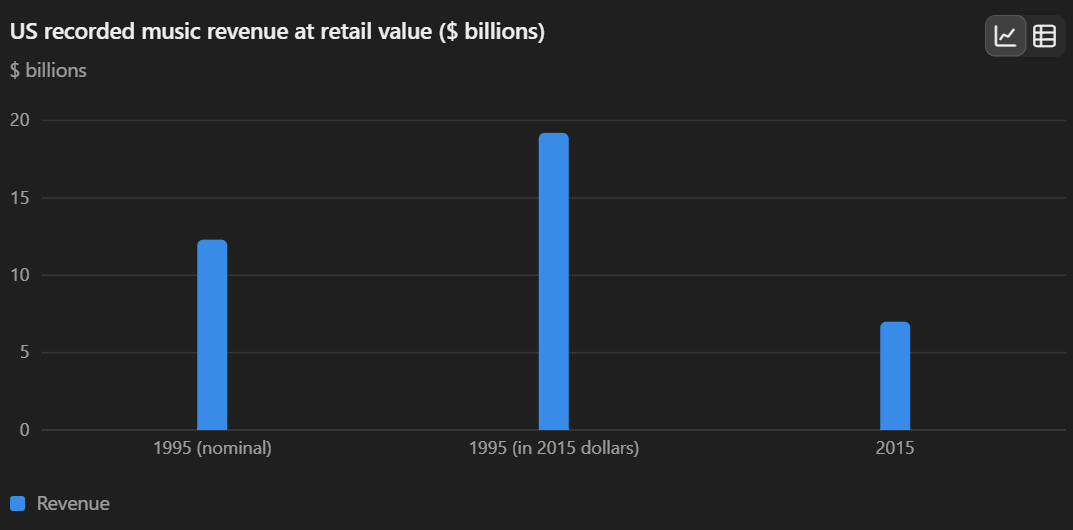 That's roughly $19 billion in 2015 dollars in 1995 against about $7 billion in 2015, at retail value.
Another story is that YouTube wasn't a benevolent helpful friendly techie just building and creating and so enlightened but actually just Silicon Valley mopping up the remnants of the music industry after it has been obliterated by peer to peer piracy. The creator economy is brutal and a small solace for the musicians I know. Sure there are some isolated success stories but like look around: things are harder for normal people. O'Reilly again:
The game I want us to play is one in which all of us build the future together, so that we control this wonderful new wave of technology for ourselves.
Yes and that will take more of what we saw the last few decades. We are living through epic, quite turbulent times. This will require a more muscular competent state. Civic tech is just the start. It'll take new protocols beyond digital tools like MCP but also new institutional structures along with the courage to let go of specific obsolete institutions.[1]
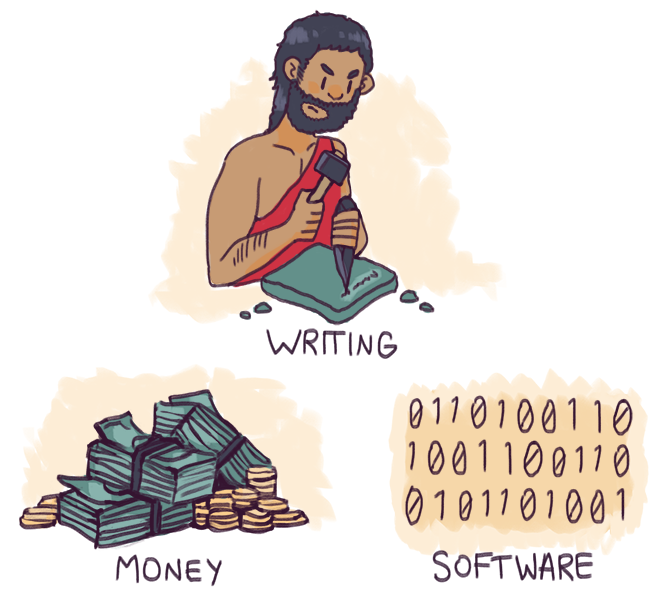
Each prior variable purpose technology like counting or writing or the oft invoked printing press resulted in profound reshapings of how we structure society. We ought to have the courage to dream and act at a similar scale, particularly given the size of the challenges we face.
[1] (That's why I'm running for my local water board. It's also a good reason why to read widely and engage in the Blygosphere as a sensemaking institution as we navigate large civilization scale shifts.)