In response to
And Yet Here We Are 🚀 · Aneesh Sathe · “Thicket Glass Bead Game [TGBG] Thread This thread will be periodically updated t…” · item 6zwqn940f7d167kh5cws4w5nzg, v1 · <https://blyg.aneeshsathe.com/t/6zwqn940f7d167kh5cws4w5nzg/> · retrieved Oct 28, 2026
Building the Bridge Atlas
For my fellow glass bead enthusiasts in The Thicket: What if we look beyond convention and maps and rules?[1]
“I understand now that boundaries between noise and sound are conventions. All boundaries are conventions, waiting to be transcended. One may transcend any convention if only one can first conceive of doing so.” - Cloud Atlas
Look beyond the ascii art and one see shapes, alterations as replies hand off from one creator to another.
B1] What is not dying in the Gramsci Gap?
from And Yet Here We Are 🚀 ↗ · excerpt of v1
│ ├── [B2] Places are made of slightly dead Spaces
│ │ │ ├── [B4] (placeholder)
Music offers ways to show a series of soloists, a concept made famous by the acclaimed novel and now movie quoted at the start of this post.
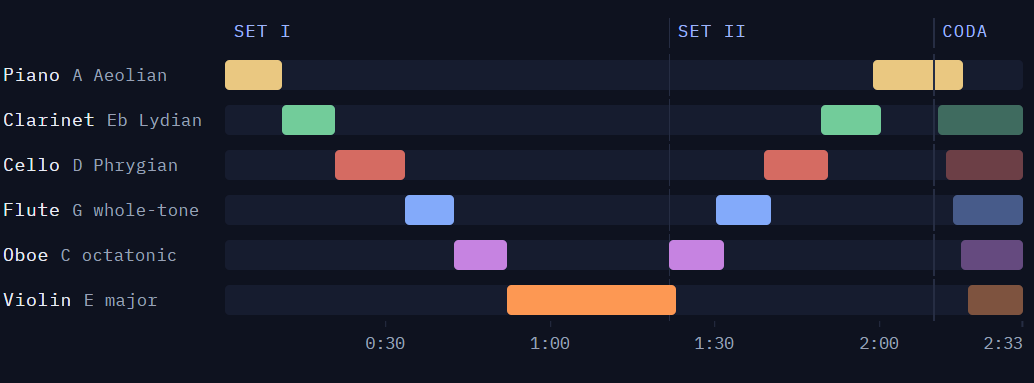
Listen along here if you like to what my ai amanuensis put together based on the description from the novel Cloud Atlas: https://claude.ai/artifact/T7t12G3JuEJzxpcVh1RW4t
(Note I still prefer and am listening to the Cloud Atlas Sextet score from the movie, which notably adheres less to the description in the book than this AI generated riff.) https://www.youtube.com/watch?v=C2U-lL_qdTI
Such joy and levity and spirit... AI offers us tools of profound conviviality. For all the talk of AI as superintelligence or a new general purpose intelligence and blather about the end of the world (or people closer to the dirt wondering what all the fuss is about and if this is yet another Pets dot com style fiasco...), I have found that the framing of AI as:
most variable-value technology ever invented. One sign is that you don’t know whether a token is worth a penny or a million dollars without knowing what problem it’s being applied to under what conditions. So it’s best to think of it as a variable-purpose technology rather than a general-purpose technology. This is extremely weird. While many economic goods have values that depend on context, especially under distorted market conditions, this is the first good whose value depends entirely on context, even in undistorted perfect market conditions.
from Venkatesh Rao's Blyg ↗ · excerpt of v2
Perhaps that explains the profound angst so many feel today. AI upends deeply held collective and individual assumptions. An important task then is to create conviviality and space for showing rather than telling its uses, bringing the promethean fire to warm the tribe, cook food, and light the way.
The fire of AI is here, and events like proof dumps are still rippling through our collective sensemaking apparatuses. Terrance Tao talks of an epochal shift to proof abundance. What does that mean? Folks in the Internet of a Thousand Lies use lazy lay definitions of mathematics, as if that area of human inquiry had a consensus definition.[2]
A college roommate of mine loved the book Godel, Escher, Bach: an eternal golden braid. I never read that though it struck me as Glass Bead-like, an intellectual interplay of abstract patterns across domains. That spirit of intellectual fervor and ferment is what attracts me to blygging.
AI offers an infinitely patient librarian. Transcludes and updates offer the ability to learn and share and engage in dialogue. What if we used these tools to not just engage in the abstract sleepwalking of a mathematicians symbolic manipulation[3] but to dream, to share new frontiers, even if they are not of the stars but rather the reflections of muddy puddles, the world discovered anew through a child's eyes in a backyard?
We are embarking on a strange chapter in humanity's story.
Is the prime radiant project something that can be actually useful or an idle hobby of a few internet randos? Are these protocol connections intellectual abstractions or useful tools for solutions that touch dirt?[4]
Blygs offer ample subjects, enough fodder for fertile discussion to last a thousand organic lifetimes and even more artificial explorations of symbolic manipulations.
Your subjects are already abundant: protocols, thickets, Prime Radiant, AI, capitalism, geography, writing, institutions, history.
from And Yet Here We Are 🚀 ↗ · excerpt of v1
Might not blygs serve as a scaffolding for a new weird and wonderful Bridge Atlas between the fragmented fediverse, our new town square that's already gone digital but which is more like a Wild West saloon than the civilized salon we need to discuss and dialogue and yes occasionally debate matters of the day?
An intellectual I admire once offered the idea that blockchain offered the tooling to end the upstream digital ad crazed cacophony that's amplified the culture war. The blyg protocol feels flexible and simple and extensible enough to serve as a "small piece, loosely joining" the fractal and fragmented dark forest of the internet. Cloud Atlas ends as a circle as humanity's far future comes back into the past, with our technologies doomed by our own desires.
Rather than today's bizarre and broken timeline that so many seem to be resigned into, or really many resigned into garden tending as folks tire of hyperventillated fearmongering about the charybdis and scyllas of the day... Why not...
- Creating a world where anyone from anywhere has not just a right to repair but the ability to enage with robots on free and open terms in a level marketplace.
- Refactoring institutions from the information flows up to enable AI native data operations and showing rather than telling what that reimagination means.
- Develop a global dataset of every metered drop of water sold on our pale blue dot (and while we're at it, do electricity too, along with gas and randomized instrumentation to get trash)
- Build a network of applied researchers in the spirit of the OG Bureau of Municipal Research that pioneered the archictecure for modern public administration that is now gumming up its gears.
- Develop New Nature as a first class concept for making sense of the world we're entering and articulate what terraforming as a viable path for actually winning this damn world war zero rather than obliterating humanity.
To give but a few aspirationally crimson and admittedly very biased examples of Protocolization's possibilities.
[1] this post breaks the first rule of the glass bead game as enumerated by Aneesh:
A move is a bead. Every reply contains at most 1,000 characters, i.e. a stub equivalent. A move you are embarrassed by is better than no move. Play!
from And Yet Here We Are 🚀 ↗ · excerpt of v2
https://blyg.aneeshsathe.com/t/31fsatfshrm695fwk1zw75v7sp/
[2] Biology is the study of life. Chemistry is the study of matter. Math is the study of, well, math :P
[3] Brian Rotman is a mathematician-turned-semiotician whose books treat mathematics as a practice of writing and signs rather than a window onto timeless objects. In Signifying Nothing: The Semiotics of Zero (1987), he argues that zero arrived as a sign about other signs, a "meta-sign" marking an absence, and that this changed how Western mathematics, money, and perspective painting could imagine infinity and the vanishing point. Ad Infinitum… The Ghost in Turing's Machine (1993) goes after the idea of the endlessly repeatable act, asking what "and so on" quietly assumes about a person who counts. Mathematics as Sign: Writing, Imagining, Counting (2000) is his fullest statement. He splits the mathematical scene into a Subject who thinks, a Person who writes, and an Agent who carries out the operations, and he treats the "imaginary" in mathematics as something generated by the scripts we inscribe.
What interests me for this thread is his view of the sign as an instruction. A mathematical text, for Rotman, is less a report of facts than a set of directions: let x be, consider, continue in this way. It addresses a reader and asks them to do something, to imagine a move, run a procedure, follow a pattern out past what anyone could actually complete. The proof is a script the reader performs, and the shared understanding comes from performing it together. That is close to the glass bead game's rule that a move is a bead, and close to showing rather than telling. Symbols are choreography for another mind, and the "abstract sleepwalking" I worried about above may be what happens when we forget there is a body on the other end of the instruction.
[4] Grass btw is too neat and tidy for the wildness that's needed to get away from the digital world. It also uses a lot of water which is heretical for frivolous uses in my family :P