In response to
And Yet Here We Are 🚀 · Aneesh Sathe · “Damn, this is very nonobvious. Wouldn’t the critter get eaten before its predato…” · item 41wg0fcefg3z2ctba2ea8gexqc, v1 · <https://blyg.aneeshsathe.com/t/41wg0fcefg3z2ctba2ea8gexqc/> · retrieved Nov 20, 2026
Damn, this is very nonobvious. Wouldn’t the critter get eaten before its predator dies though 🤔
I just learned that one of the reasons for deep-sea bioluminescence is to attract predators. As in “bump me and I’ll light up, and then something bigger then either of us will come and you are more their prey size than I am”.
In the dark forest / tangled bank, the dominant environment is alive. Whereas in the deep sea, the dominant environment is empty space. The flower-guy monster from S1/S2 of stranger things is also from this “empty space” paradigm.
from blyg.nedshed.dev ↗ · snapshot of v1
from Venkatesh Rao's Blyg ↗ · snapshot of v2
I’m guessing it’s a numbers game. Sacrificing one unit of prey is worth many more for the population. Where nutrients are sparse the ability to have a population boom due to predator depletion must be selective?
from And Yet Here We Are 🚀 ↗ · snapshot of v1
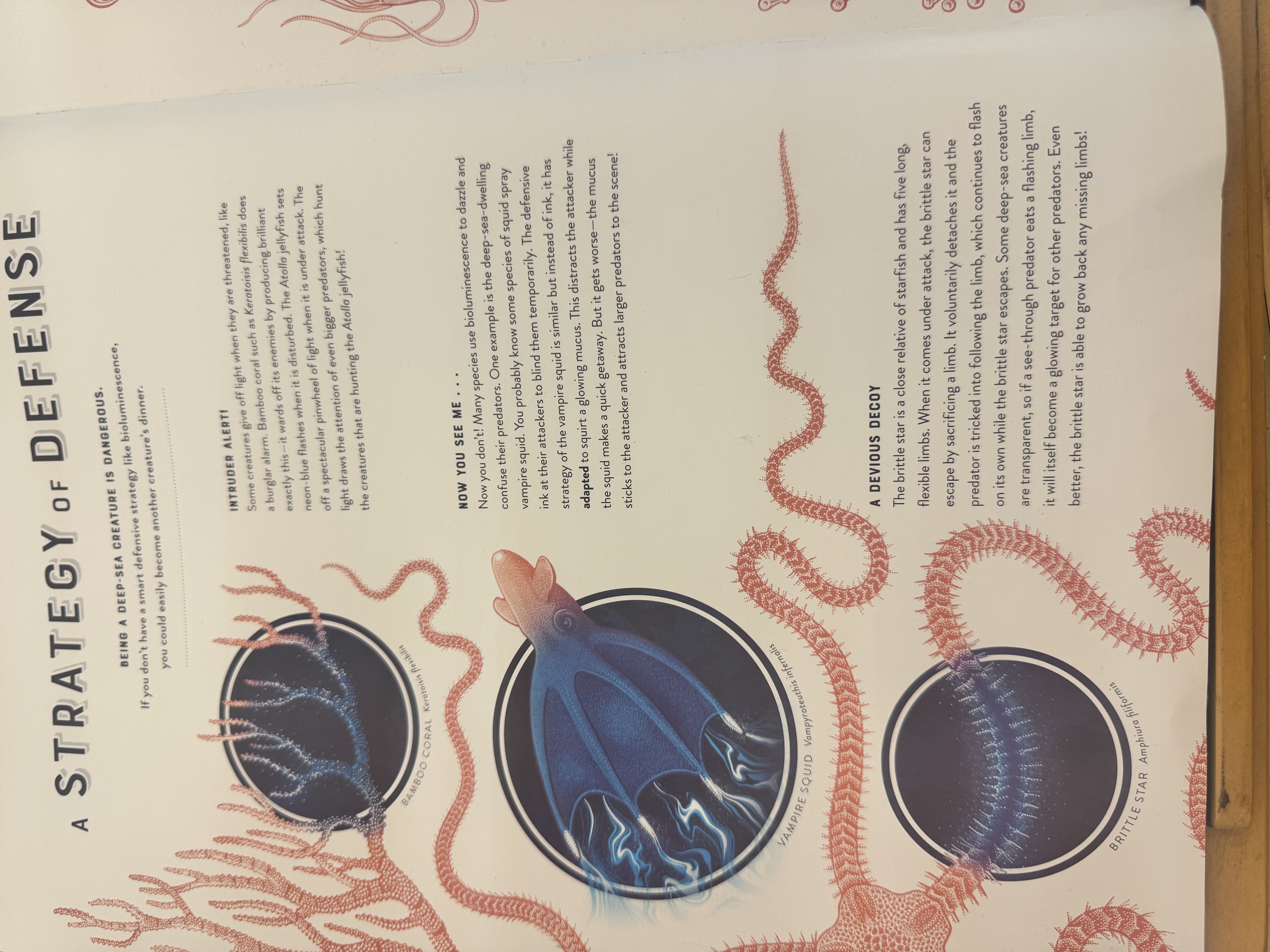
Wow cool! One thing I have taken away from dipping my toe into bio is that millions and billions of years of evolution produce no obvious outcomes. We humans are really not built to think at that number of iterations intuitively.
Also regarding the evolutionary logic, from my Claude:
The strategy is well documented as a hypothesis, and some of the supporting evidence is experimental, such as the work on dinoflagellates that light up and draw predators to their attackers. For many deep-sea species, though, it's inferred from the behavior and the setting, because watching these animals in the wild is hard. So it's solid as a plausible, well-supported explanation, but not every species that glows has been shown to use it this way.