The measurement problem in carbon removal
Here's a little problem that's actually a big challenge for how we decarbonize in time to avoid calamity: measurement.
I spent a lot of time working on that through the specific regional issue of water efficiency back when I was running the CA water data collaborative. There are a lot of measurement issues with how much water is saved as those calculations are used to determine incentive amounts.
Indoor water usage which has largely mechanical determinations of deltas was more in the comfort zone of legigibility seeking institutions. Indoor average point estimates for the water use change for a single family home with 4 people make sense as toilets are used however much they're used.
Outdoor water use which involves a lot of behavioral shifts is a bit different. Outdoor watering though involves a lot of behavior and variation such as specific plant types, microclimates, whether people remember to water, attitudes towards new plants etc. The point is the variation is wider and that takes different strategies.
There's a lot of lessons for carbon removal and mitigation. Consider the following charts and specifically look at promising methods like mineralization or regenerative agriculture.
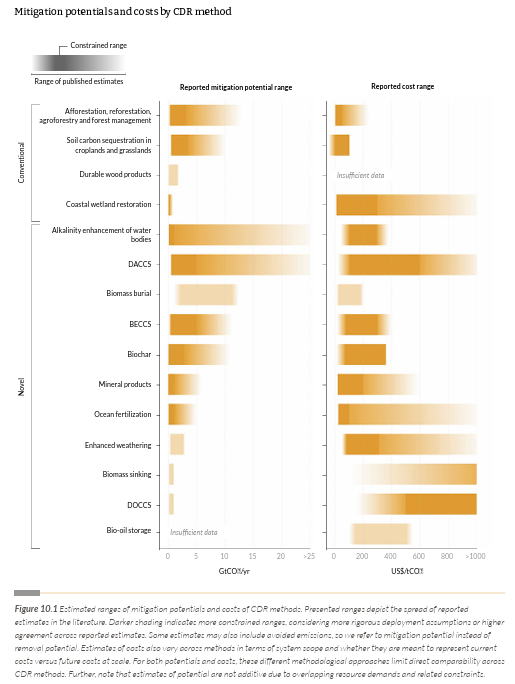
Source: https://www.stateofcdr.org/asset/SoCDR-Ed3_Chapter-10_Final.pdf
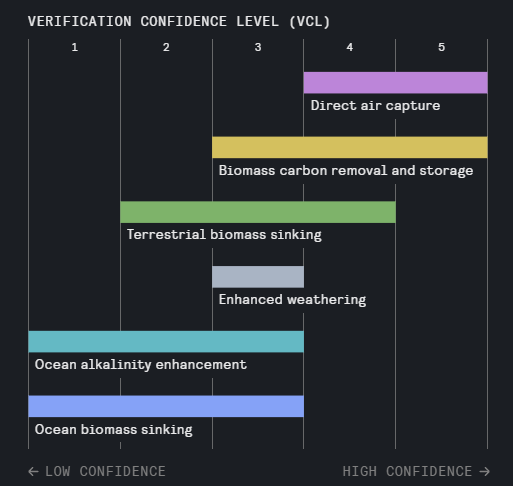 The webpage has a nice description of what VCLs mean and the categorization methodology: https://carbonplan.org/research/cdr-verification-explainer
I have a bias for lower cost "good enough" measurements that are actionable rather than analysis paralysis seeking "ideal data." This is important as the costs of these technologies and methods are not fixed! How those cost ranges evolves is a function of their learning rate which will be determined by deployments.
Having good enough measurements to confidently fund various approaches will be critical. So far industry has had to lead the way through the Frontier Carbon initiative. Ultimately however the scale of the decarbonization challenge will require public funding. That will require more and better measurement to deploy.
Remote sensing is improving by leaps and bounds but in my experience always benefits from calibration by in situ sensors. I wonder why a place like California does not have such a sensor network. There is a highly successful precedent in the California Irrigation Management Information System which calculates reference ET using a modeled approach from measured wind speed, temperature, solar radiation etc.
There are various scientific sensor networks such Fluxnet which serves as a network of sensor networks. Those seem to be geared towards scientific modeling rather than the applied problem of measuring and incentivizing specific decarbonization. Regenerative ag would benefit from a public network of carbon flux data along with interpolation a la CIMIS, spatial CIMIS, Open ET.
I still don't have a great sense of cost and the logistics involved though am curious to learn more. Thanks for reading as I learn and explore in public.
TK
- Look at the larger context of the geologic carbon cycle
- Scope specific sensor costs and look at existing networks
- Reread and connect to https://protocolized.summerofprotocols.com/p/disentangling-the-state-of-climate
v3
PAtwater